

Cutting indian sandstone paving well is what separates a neat, professional finish from a cracked slab and wasted stone. You need to mark accurately, choose the right blade, support the slab fully and control dust. This guide explains each step, from planning your cuts to finishing the edges, so you can trim slabs around walls, drains and corners with confidence.
Contractors, builders and landscapers can use these tips to save time, reduce waste and work more safely.
Why Does Indian Sandstone Paving Need Careful Cutting?
Sandstone forms from sand grains bound by natural minerals. It feels hard, yet it can split along its bedding layers. Rushed cuts often crack or chip for that reason.
Finish and thickness change the job. Riven slabs have uneven faces, so mark them with care. Sawn and honed slabs are flatter and cut more predictably. Many indian sandstone paving slabs are 20mm to 30mm thick, so blade depth matters.
Colour matters too. Kandla Grey Sandstone is dense and cuts cleanly. Fossil Mint Sandstone has fine fossil-like patterns, so check for natural lines before you mark. Raj Green Sandstone blends several tones, and the bands can vary in hardness, so slow down near colour changes. Every piece of natural sandstone is unique, so treat each slab as its own small job.
Which Tools Do You Need to Cut Sandstone Paving?
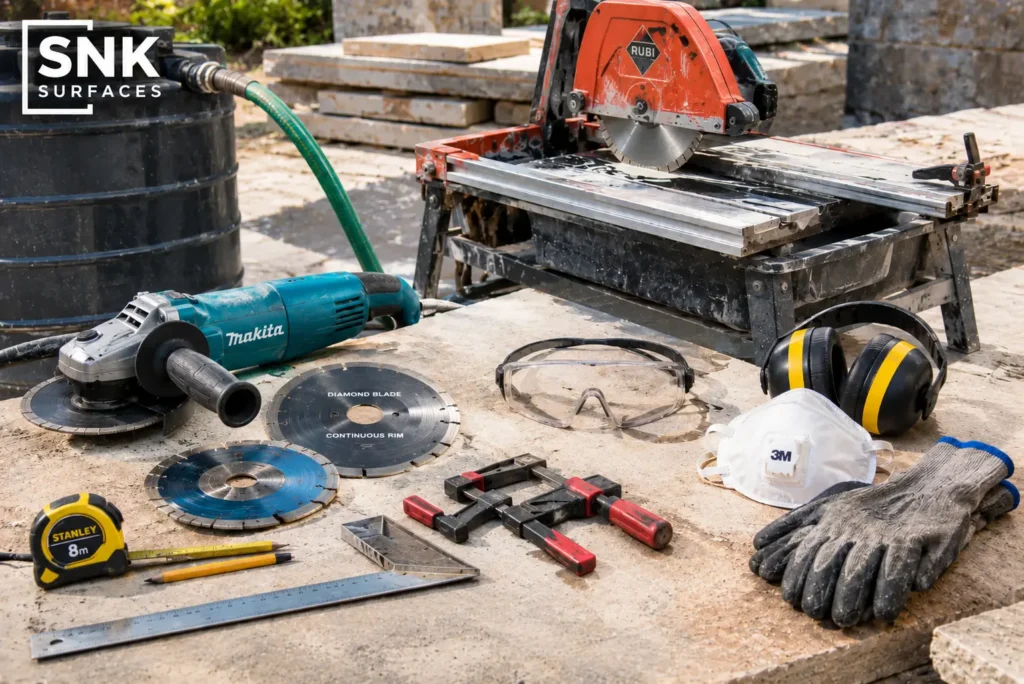
Good tools give clean edges. Gather these first:
- Angle grinder with a diamond blade
- Wet saw or masonry saw
- Continuous rim diamond blade
- Tape measure, pencil, straightedge and set square
- Clamps, trestles and a flat support
- Water supply or dust suppression
- Diamond hand pad for edges
- Goggles, gloves, ear defenders and a respirator
Can You Cut Sandstone With an Angle Grinder?
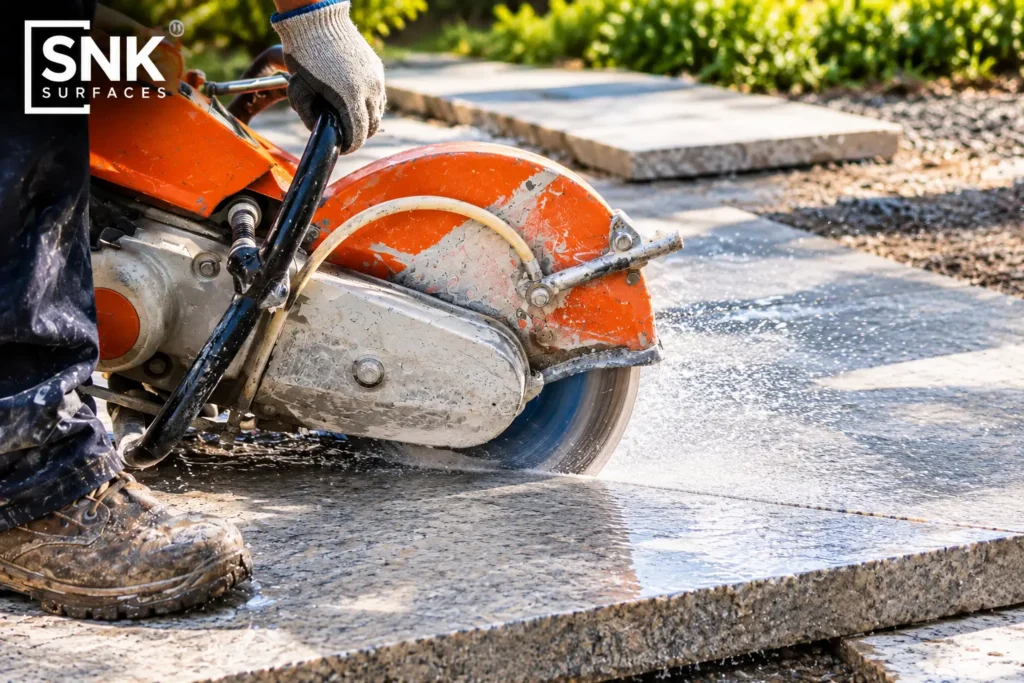
Yes. A grinder suits short cuts, notches and curves. Fit a 115mm to 230mm diamond blade rated for stone. Grinders are quick but dusty, so use water or extraction.
When Should You Use a Wet Saw?
Choose a wet saw for long, straight and repeat cuts. Water cools the blade, settles dust and improves the edge. A continuous rim blade chips less than a segmented blade, which cuts faster but leaves a rougher edge.
How Do You Measure and Plan Your Cuts?
Dry lay the slabs first. Do not cut until the layout looks right.
Measure each gap at the actual cut position, not from the plan. Subtract the joint width, which is often 10mm for indian paving sandstone. Mark the line on the face with a pencil and check it twice.
Use a set square for angles. For curves, trace a card or plywood template. Plan cuts so offcuts become border or edge pieces. Slivers under 50mm break easily, so shift the full slabs in the row to avoid them.
How Do You Prepare and Stay Safe?
Support the whole slab on a flat surface. Never let the waste piece hang free, because its weight can snap the slab before you finish. Clamp the stone or rest it on a non-slip mat. Work outdoors or in a well-ventilated space.
Sandstone contains crystalline silica, and breathing the dust can cause serious lung disease. The UK Health and Safety Executive explains good practice for controlling silica dust when cutting stone, and water suppression is a key control. Wear a suitable respirator, eye protection, gloves and ear defenders. Keep bystanders away. Clean up with a suitable vacuum or by wet sweeping, never by dry brushing.
Check the blade for cracks before each job. Never force the cut.
How Do You Cut Indian Sandstone Paving Step by Step?
Follow this method for sandstone indian paving and most other sandstone paving.
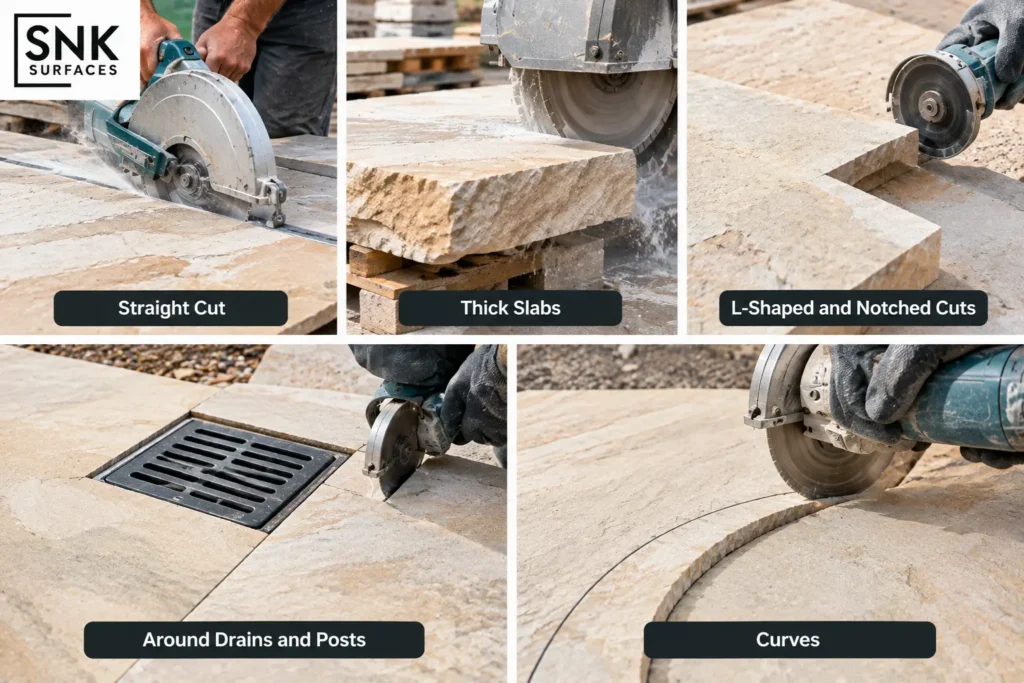
How Do You Make a Straight Cut?
- Secure the slab with the marked face up.
- Make a shallow scoring pass, about 3mm to 5mm deep, along the line.
- Make a second, deeper pass. Keep the blade straight and let it do the work.
- Repeat until the blade cuts through.
- Support both sides as you finish, so the piece does not snap off.
How Do You Cut Thick Slabs?
For thick slabs, cut in stages from both faces. Use a wet saw with enough blade depth. A grinder cannot safely cut through a very thick slab in one pass.
How Do You Make L-Shaped and Notched Cuts?
Drill a small hole at the inside corner first. It stops cracks from starting at the sharp point. Cut each line up to the hole, then remove the waste piece.
How Do You Cut Around Drains and Posts?
Make a card template and test it on the ground. Trace it onto the slab. Cut short relief lines toward the shape, remove the waste and grind the opening to size.
How Do You Cut Curves?
Cut short straight sections toward the curve line. Snap off the waste, then grind the edge smooth in small bites.
Which Method Suits Which Job?
| Cutting need | Best method | Key point |
|---|---|---|
| Straight cuts | Wet saw or masonry saw | Accuracy |
| Small adjustments | Angle grinder | Control |
| Thick slabs | Professional stone saw | Cutting depth |
| Curved cuts | Grinder with diamond blade | Finishing |
| Detailed shapes | CNC or professional fabrication | Precision |
How Do You Finish Cut Edges?
Smooth a fresh edge with a diamond hand pad or rubbing stone. Work along the edge, not across it. Ease sharp corners lightly. On riven slabs, soften the edge with a coarse pad so it blends with the natural face.
Place cut edges against walls, borders or planting where possible. Then they stay hidden. Seal the cut edge as well, because freshly cut stone is unsealed and absorbs water and stains.
What Problems Can Happen, and How Do You Fix Them?
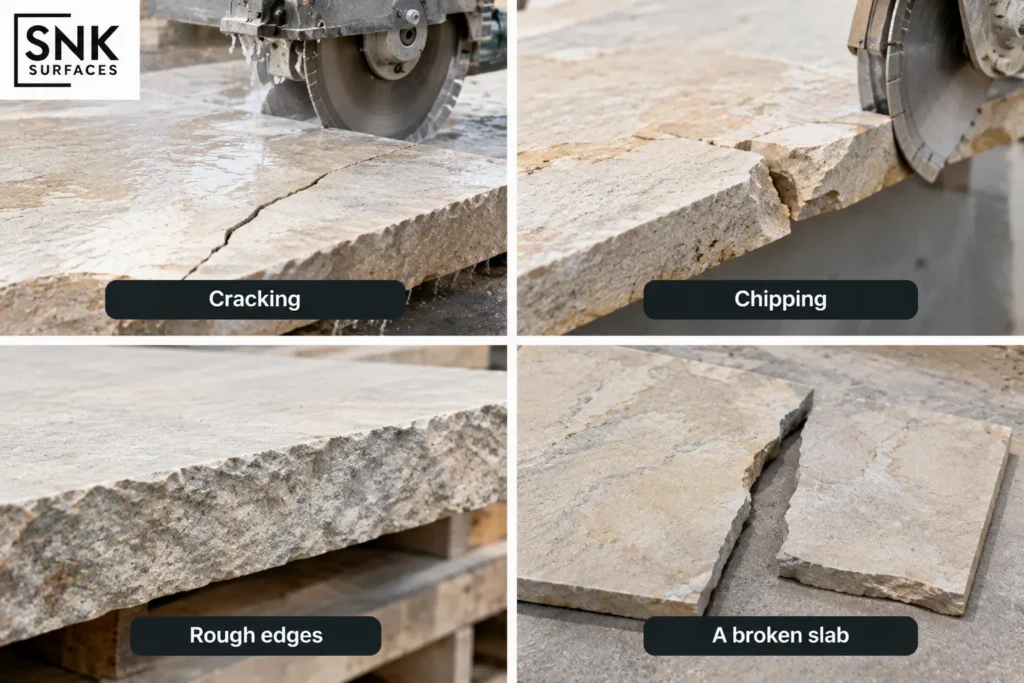
- Cracking: Forcing the blade, poor support or heat build-up causes it. Slow down, support the slab and keep water flowing.
- Chipping: A dull or wrong blade causes it, and so does skipping the scoring pass. Switch to a continuous rim blade and re-score.
- Rough edges: A wobbling blade or loose clamping causes them. Secure the slab and replace worn blades.
- A broken slab: Keep the pieces. They often work for small infill cuts.
To reduce waste, leave 2mm to 3mm of allowance and trim to fit. Group similar cuts together, and reuse offcuts in borders.
Should You Cut On Site or Order Pre-Cut Pieces?
On-site cutting works for trims and small adjustments. Factory cutting suits repeat sizes, circles, radius edges and large commercial layouts. It also cuts dust and noise on your site.
When you order cutting sandstone paving to size, give your supplier a drawing with dimensions, thickness, finish, quantity, tolerance and edge detail. Ask about lead times and packing too. Precision-cut stone suits patios, pool surrounds, steps and commercial plazas.
How Do You Care for Sandstone After Cutting?
Rinse away slurry with clean water before it dries. Let the stone dry, then seal cut edges along with the surface if your sealer allows. Protect edges during installation by handling slabs on their long edge and avoiding drops.
Why Choose SNK Surfaces for Indian Sandstone Paving?
Buyers pick SNK Surfaces because we combine manufacturing control with reliable export. We source, cut, inspect and pack indian sandstone slabs in India, and our certified processes help keep quality consistent from order to order. We also supply natural stone and porcelain surfaces to importers, distributors and contractors worldwide.
Need stock closer to your site? Our UK warehouse holds selected paving products, so UK customers can order from local stock and receive faster deliveries. Landscapers, contractors and construction teams can plan jobs with more confidence. For larger or custom projects, we still ship directly from India.
Frequently Asked Questions About Cutting Indian Sandstone Paving
Can you cut sandstone with an angle grinder?
Yes. Use a diamond blade rated for stone, score first and control dust with water or extraction.
What is the best blade for cutting sandstone?
A continuous rim diamond blade gives the cleanest edge. Segmented blades cut faster but chip more.
Can sandstone paving be cut to any size?
Mostly, yes. Very thin strips break easily, so avoid slivers under 50mm.
Is it better to cut sandstone wet or dry?
Wet is better. Water cools the blade, reduces dust and improves edge quality.
How do you cut sandstone without chipping it?
Score a shallow line first, use a sharp continuous rim blade and support the slab fully.
Can you cut sandstone paving by hand?
Small trims are possible with a bolster and hammer. Results are less precise and take more skill.
How thick a sandstone slab can you cut?
It depends on blade diameter. Thick slabs need a wet saw or a professional saw, and cutting from both faces.
How do you cut curves in Indian sandstone paving?
Cut short straight sections toward the line, remove the waste and grind the curve smooth.
Does cutting affect sealing?
Yes. Cut edges are unsealed, so treat them with sealer after cleaning and drying.
Can a supplier provide custom-cut pieces?
Yes. SNK Surfaces can supply custom sizes and shapes when you share dimensions and finish details.
Final Thoughts: Choose the Right Cutting Method
Cutting Indian sandstone paving is easy when you plan first, score before deep cuts and support every slab. Use a wet saw for straight lines and a grinder for detail. Choose factory cutting when you need speed and precision on large jobs.
Ready to source quality stone? Explore Indian sandstone paving from SNK Surfaces and talk to our team about sizes, finishes and custom cutting.