

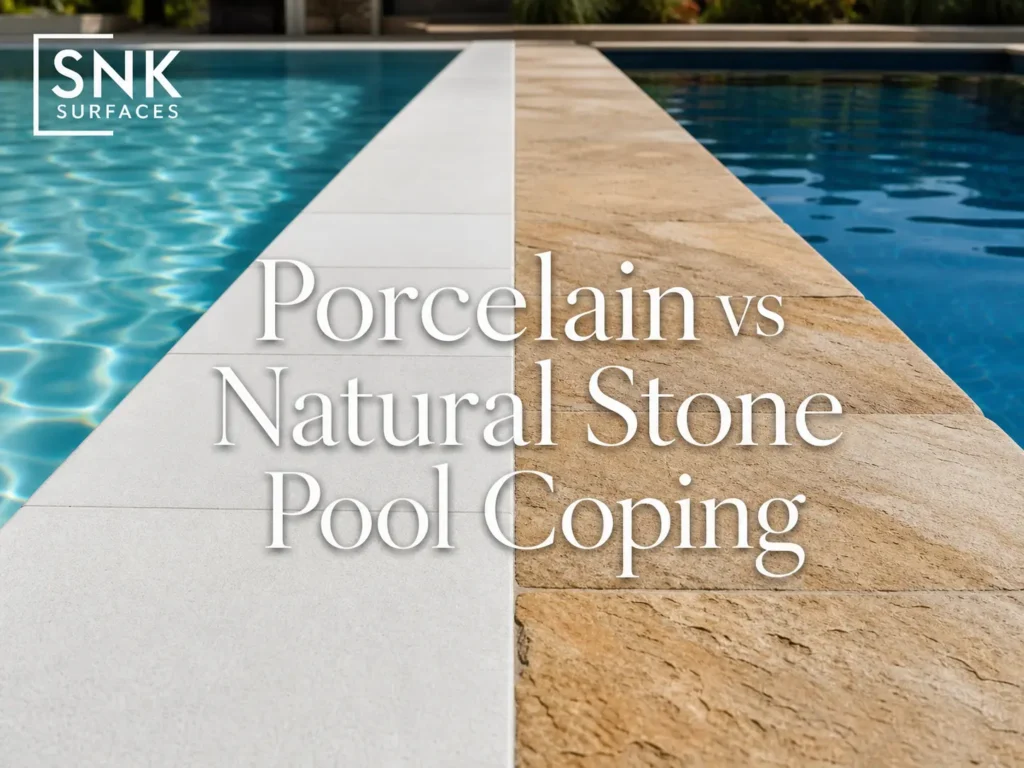
When designing or installing a swimming pool in the UK, the pool edge is the most important decision you will make on the entire project.
It sits right at the waterline. Every single day it faces chlorinated water, heavy foot traffic, and in the UK brutal freeze-thaw cycles through winter. Get this decision wrong and within a few years you are looking at cracked stones, green algae, dangerous slip hazards, and expensive remedial work.
So when the debate comes down to porcelain vs natural stone pool coping, the stakes are genuinely high.
In this guide we will break down exactly what separates these two materials the technical data, the maintenance reality, the design possibilities, and the logistics so you can make the right call for your next project.
Understanding the Pool Environment First
Before comparing porcelain vs natural stone pool coping, it helps to understand what these materials are actually up against.
A pool surround is not a standard garden patio. The coping stones sit directly on the waterline and face:
- Daily splashing with chlorinated or saltwater
- Constant barefoot traffic from wet feet
- UK winters with repeated freeze-thaw cycles
- Chemical cleaning products and algae growth
If your chosen material cannot handle all of these simultaneously, the project will fail regardless of how good it looks on day one.
What Is Natural Stone Pool Coping?
Outdoor stone pool coping has been the standard for high-end residential pools for centuries. Materials like granite, limestone, and sandstone are quarried directly from the earth, cut into blocks, and shaped into coping stones.
The appeal is obvious. Natural stone has a warmth and organic character that no engineered material can fully replicate. Our Kandla Grey Sandstone for example features subtle natural tone variations that give a pool surround a deeply authentic, traditional feel perfectly aligned with guidelines from The Stone Federation Great Britain.
But natural stone comes with one significant physical limitation it is porous.
Depending on the type of stone, outdoor stone pool coping can have a water absorption rate of between 1.5% and 5%. In practice this means:
- Pool water, oils, and algae can be absorbed into the stone
- In winter, absorbed moisture freezes, expands, and causes the stone to crack a process called spalling
- Organic stains from leaves, sunscreen, and algae become very difficult to remove
To protect against this, natural outdoor stone pool coping must be sealed with a high-quality penetrating sealant immediately after installation and this process must be repeated every one to two years.
For busy contractors and property developers, that ongoing maintenance commitment is a significant factor in the porcelain vs natural stone pool coping decision.
What Is Vitrified Porcelain Pool Coping?
Vitrified porcelain pool coping is an engineered material that has fundamentally changed the pool coping industry over the last decade.
It is manufactured by taking highly refined clays, sand, and minerals, pressing them under extreme pressure, and firing them in a kiln at over 1,200 degrees Celsius. This process called vitrification fuses the materials into a solid, glass-like state.
The result is a set of porcelain pool coping stones that are technically superior to natural stone in almost every measurable way. Modern manufacturing also allows factories like ours in Morbi, India to produce vitrified porcelain pool coping that authentically mimics the look of natural stone, timber, or concrete without the maintenance burden.
Porcelain vs Natural Stone Pool Coping – The Complete Comparison
Here is how these two materials stack up across the five categories that matter most on a real project.
1. Water Absorption and Frost Resistance
This is the most important metric in the porcelain vs natural stone pool coping debate.
- Natural stone: Absorbs between 1.5% and 5% of moisture
- Vitrified porcelain: Absorbs less than 0.05% officially classified as impervious
Because porcelain pool coping stones do not absorb water, they are completely frost-proof. In a UK winter, moisture simply cannot penetrate the surface so there is nothing to freeze, expand, and crack the stone.
For any UK or Northern European project, this single factor alone makes vitrified porcelain pool coping the safer long-term choice.
2. Resistance to Pool Chemicals
Swimming pools use heavy doses of chlorine, acid, and salt to keep water clean.
- Natural stone: Over time, chlorine and saltwater can erode outdoor stone pool coping. Saltwater pools in particular cause severe pitting and surface degradation in sandstone and limestone.
- Vitrified porcelain: Completely inert. Vitrified porcelain pool coping is highly resistant to acids, alkalis, salts, and chlorine. You can splash concentrated pool chemicals directly onto porcelain pool coping stones without any surface damage or colour fading.
3. Maintenance and Sealing
This is where the porcelain vs natural stone pool coping decision becomes very clear for most trade buyers.
- Natural stone: Must be sealed after installation and resealed every one to two years. Without sealing, outdoor stone pool coping will stain from leaves, sunscreen oils, algae, and pool chemicals.
- Vitrified porcelain: Zero sealing required ever. Because the surface is permanently fused at 1,200 degrees, it is completely closed. A simple wash with warm soapy water or a light pressure wash keeps porcelain pool coping stones looking brand new for decades.
For contractors managing multiple projects and for property developers offering long-term warranties, the zero-maintenance nature of vitrified porcelain pool coping is a significant commercial advantage.
4. Slip Resistance and Safety
Pool surrounds are wet, barefoot areas. Safety is non-negotiable.
- Natural stone: Can provide excellent grip with a riven or flamed finish. However, if algae grows in the porous surface of outdoor stone pool coping which it will without regular sealing it becomes dangerously slippery.
- Vitrified porcelain: Premium porcelain pool coping stones are manufactured with a built-in anti-slip texture. Our grey porcelain pool coping achieves a P5 / R11 anti-slip rating meeting strict British Standards Institution (BSI) guidelines for commercial wet areas.
5. Design Flexibility and Colour Consistency
- Natural stone: Every batch from the quarry is slightly different. This natural variation is beautiful for traditional designs, but it makes achieving a perfectly uniform, modern aesthetic very difficult across large areas.
- Vitrified porcelain: Every batch is digitally engineered and printed. If a client wants a flawless, uniform, contemporary finish across hundreds of square metres, porcelain pool coping stones deliver exact colour consistency every time.
The L Shape Pool Coping Advantage
While the material matters enormously in the porcelain vs natural stone pool coping debate, the physical profile of the coping stone is equally important for the final aesthetic.
Traditionally, pools used a simple bullnose edge a rounded front that was easy to manufacture and install. Today, serious landscape architects and pool contractors specify L shape pool coping for premium projects.
L shape pool coping also called drop-face or rebated coping features a horizontal deck tile that connects to a vertical drop apron at a precise 90-degree angle.
Why has L shape pool coping become the specification of choice for luxury installations?
- Hides the pool shell: The vertical drop of the L shape pool coping completely covers the concrete joint where the pool structure meets the deck giving a clean, finished appearance from every angle.
- Creates the illusion of mass: Even with a 20mm deck tile, an L shape pool coping with a 60mm vertical drop gives the visual impression of a thick, solid stone edge sitting on the pool like a five-star hotel pool.
- Modern aesthetics: The crisp 90-degree geometry of L shape pool coping fits perfectly with minimalist, contemporary garden and villa designs.
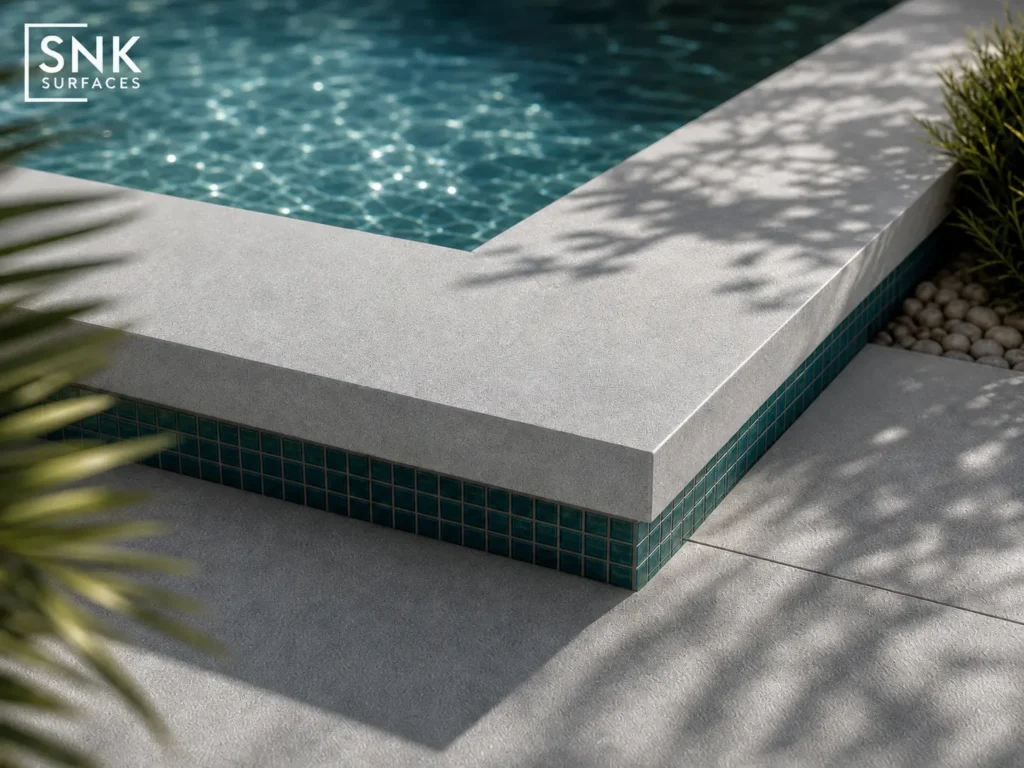
At SNK Surfaces, we specialise in manufacturing premium L shape pool coping from our porcelain ranges. Creating a true L shape pool coping in porcelain requires exceptional precision the horizontal tile and vertical drop apron must be CNC-mitered to a tolerance of under 0.5mm. Our expert stonemasons then hand-bond every piece using industrial epoxies, because a true L shape pool coping cannot be mass-produced by machines alone.
The result is a flawless, seamless pool edge that holds perfectly through UK winters without cracking, lifting, or discolouring.
Selecting Your Style: Grey Porcelain Pool Coping and Beyond
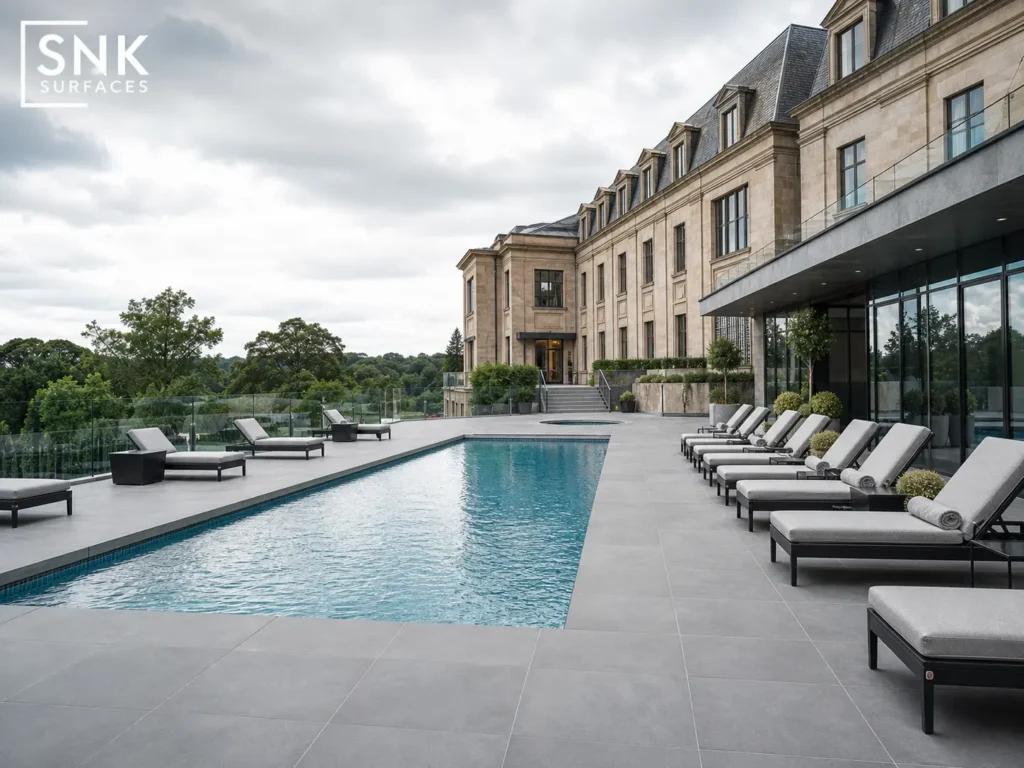
Once you have evaluated porcelain vs natural stone pool coping and decided on porcelain, selecting the right colour is the final step.
For the modern UK and European market, grey porcelain pool coping is currently the number one choice among landscape architects and pool contractors. The reason is simple grey creates a stunning visual contrast against the bright blue water of the pool while hiding minor dirt and footprint marks beautifully.
Our Rocklith Grau is a premium grey porcelain pool coping that authentically mimics the look of natural granite with all the zero-maintenance benefits of vitrified porcelain pool coping. It is available in our L shape pool coping profile and can be matched exactly to our outdoor paving slabs from the same production batch.
For a Mediterranean villa aesthetic or a bright, sun-drenched resort look, white porcelain pool coping stones are the alternative of choice. Our Crystal Bianco delivers a crisp, brilliant white edge that reflects heat keeping the porcelain pool coping stones cooler under bare feet on hot summer days.
The key advantage of ordering directly from SNK Surfaces is batch consistency. Whether you choose grey porcelain pool coping or white, we cut your coping stones from the exact same production batch as your outdoor paving guaranteeing a perfect colour match across the entire pool surround and patio.
Trade Benefits Sourcing Porcelain vs Natural Stone Pool Coping Direct
For UK and European B2B buyers, contractors, and landscaping companies, the logistics of sourcing porcelain vs natural stone pool coping directly affects project profitability.
When you order porcelain pool coping stones or outdoor stone pool coping from SNK Surfaces, you buy directly from the manufacturer in Morbi, India bypassing the heavy markups of UK stone yards and distributors.
Here is what direct sourcing means in practice:
- Container efficiency: Vitrified porcelain pool coping at a precise 20mm thickness allows significantly more square meterage per export container compared to bulky outdoor stone pool coping
- Fewer breakages: The tensile strength of vitrified porcelain pool coping means fewer transit breakages and less waste on site
- Custom fabrication: We pre-fabricate custom L shape pool coping sizes, curved radius pieces, and corner units directly at our factory saving your installation teams days of complicated on-site cutting
- Certified quality: All our porcelain pool coping stones are CE and UKCA certified ready for UK and European commercial projects
The Final Verdict – Porcelain vs Natural Stone Pool Coping
So which material wins the porcelain vs natural stone pool coping debate?
If your client wants the authentic warmth of a traditional, rustic garden and is fully committed to annual sealing and ongoing maintenance, outdoor stone pool coping remains a genuinely beautiful classic choice.
But if the project demands zero maintenance, complete frost resistance, full immunity to pool chemicals, consistent colour across large areas, and a clean architectural finish vitrified porcelain pool coping wins without question.
Add an L shape pool coping profile in a contemporary grey porcelain pool coping finish and you deliver a pool surround that looks like a five-star resort and stays that way for decades without fading, cracking, or staining.
For B2B buyers ready to import premium porcelain pool coping stones direct from the manufacturer, SNK Surfaces offers factory pricing, CE and UKCA certified quality, and export-ready packaging with full documentation.
Contact our export team today to request free sample swatches
Frequently Asked Questions
What is the main difference between porcelain vs natural stone pool coping?
The primary difference in the porcelain vs natural stone pool coping comparison is porosity. Natural stone absorbs between 1.5% and 5% of moisture and requires chemical sealing to prevent water damage and staining. Vitrified porcelain pool coping absorbs less than 0.05% and requires zero sealing offering vastly superior resistance to frost and pool chemicals.
Are porcelain pool coping stones slippery when wet?
No. High-quality porcelain pool coping stones are manufactured with a textured matte finish specifically for wet areas. Our grey porcelain pool coping achieves a P5 / R11 anti-slip rating providing excellent grip for bare feet in both commercial and residential pool environments.
What exactly is L shape pool coping?
L shape pool coping is a specialised architectural profile where the horizontal deck tile connects to a vertical drop apron at a 90-degree angle. This L shape pool coping design completely hides the concrete pool shell, creating a thick, seamless, and highly architectural edge for the swimming pool surround.
Does grey porcelain pool coping get hot in the sun?
Like all dense materials, grey porcelain pool coping will absorb some heat in direct sunlight. However, because vitrified porcelain pool coping is thinner (typically 20mm) and denser than traditional concrete or dark natural stone, it dissipates heat efficiently. For maximum heat reflection, lighter colours like white porcelain pool coping stones are recommended.
Is outdoor stone pool coping difficult to maintain?
Outdoor stone pool coping requires considerably more maintenance than porcelain. It must be sealed after installation to protect against chlorine, salt, and organic stains. This sealing process should be repeated every one to two years to maintain the structural integrity and colour of the outdoor stone pool coping.
Can I get matching patio tiles for my porcelain pool coping stones?
Yes. When you order porcelain pool coping stones directly from SNK Surfaces, we cut your coping including complex L shape pool coping pieces from the exact same production batch as our standard porcelain paving slabs. This guarantees your pool edge matches your patio flawlessly with zero colour variation.