
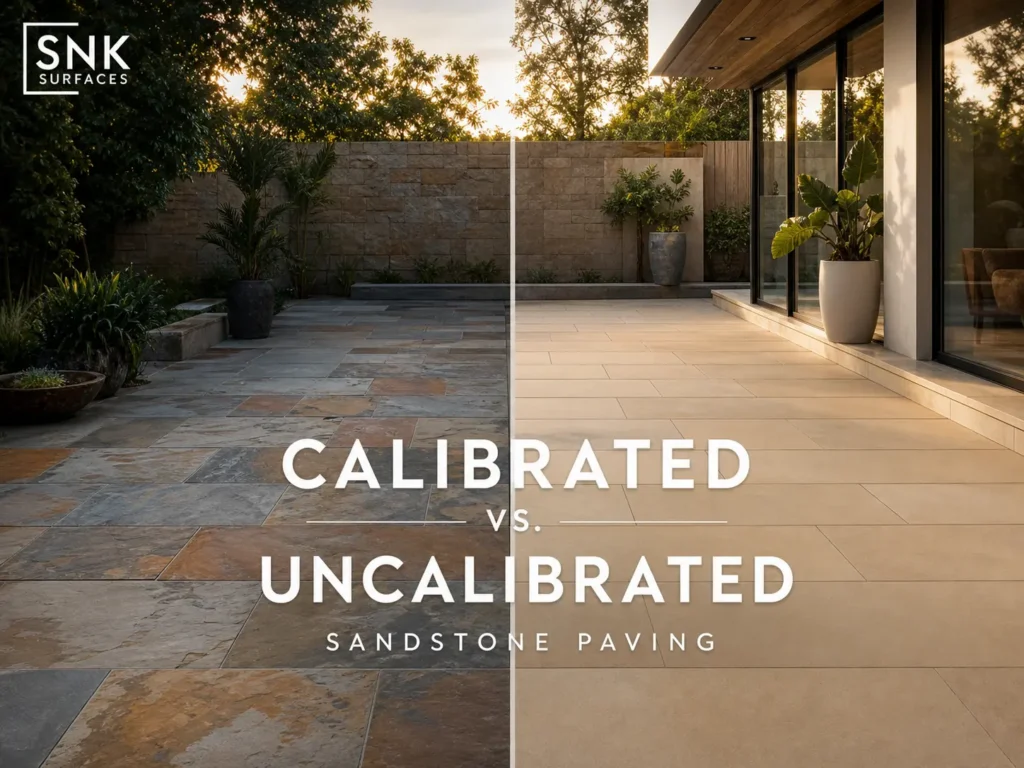
When it comes to calibrated vs uncalibrated sandstone paving, the difference comes down to one thing thickness. Calibrated sandstone is machine-cut to a consistent 22mm thickness. Uncalibrated sandstone is hand-split and varies between 25mm and 45mm. For UK landscaping and trade projects, calibrated sandstone paving is almost always the right choice it installs faster, ships more efficiently, and bonds more strongly to the mortar bed.
What Is the Difference Between Calibrated vs Uncalibrated Sandstone Paving?
If you are sourcing Indian sandstone for a UK patio, garden, or commercial landscaping project, the debate around calibrated vs uncalibrated sandstone paving is one you will come across very quickly. Understanding the difference before you place your first container order can save you significant time and money.
The difference comes down to one thing thickness.
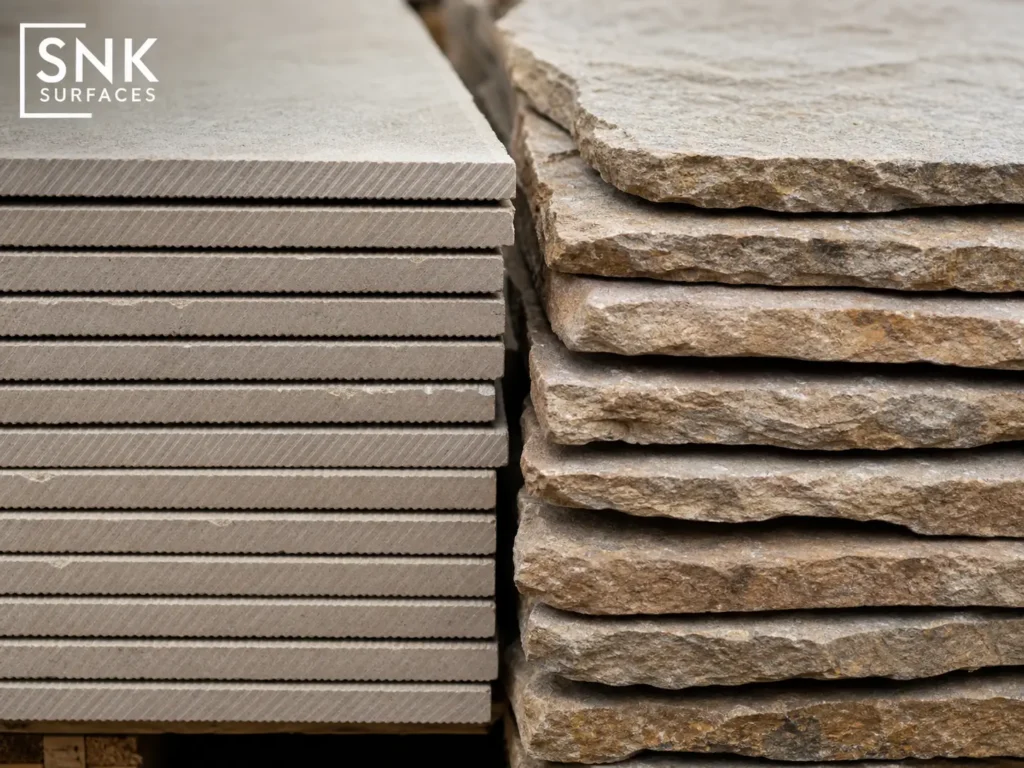
Calibrated sandstone is passed through a heavy-duty diamond-blade milling machine after it is quarried. This machine shaves the underside of every slab to a precise, consistent depth. The UK and European trade standard is 22mm (with a tolerance of +/- 2mm).
Uncalibrated sandstone is hand-split along its natural layers but never milled. The thickness varies from slab to slab sometimes even across a single slab ranging anywhere from 25mm to 45mm.
Twenty years ago, almost all Indian sandstone imported into the UK was uncalibrated. Today, that has completely changed. The trade has moved and for very good reason.
Why Has the UK Trade Moved to Calibrated Stone?
The shift happened because of one simple reality labour costs in the UK are expensive.
The faster a landscaping team can lay a patio, the more profitable the project. Calibrated stone made installation dramatically faster and more predictable. Once the trade saw the difference, there was no going back.
Here are the five main reasons UK landscapers, architects, and stone importers now overwhelmingly prefer calibrated paving.
5 Reasons UK Professionals Prefer Calibrated Sandstone
1. Faster Installation Up to 50% Less Labour Time
With uncalibrated stone, a landscaper has to manually adjust the mortar bed depth under every single slab. If one slab is 25mm and the next is 40mm, they have to remove 15mm of wet mortar to keep the surface level. This is slow, exhausting work.
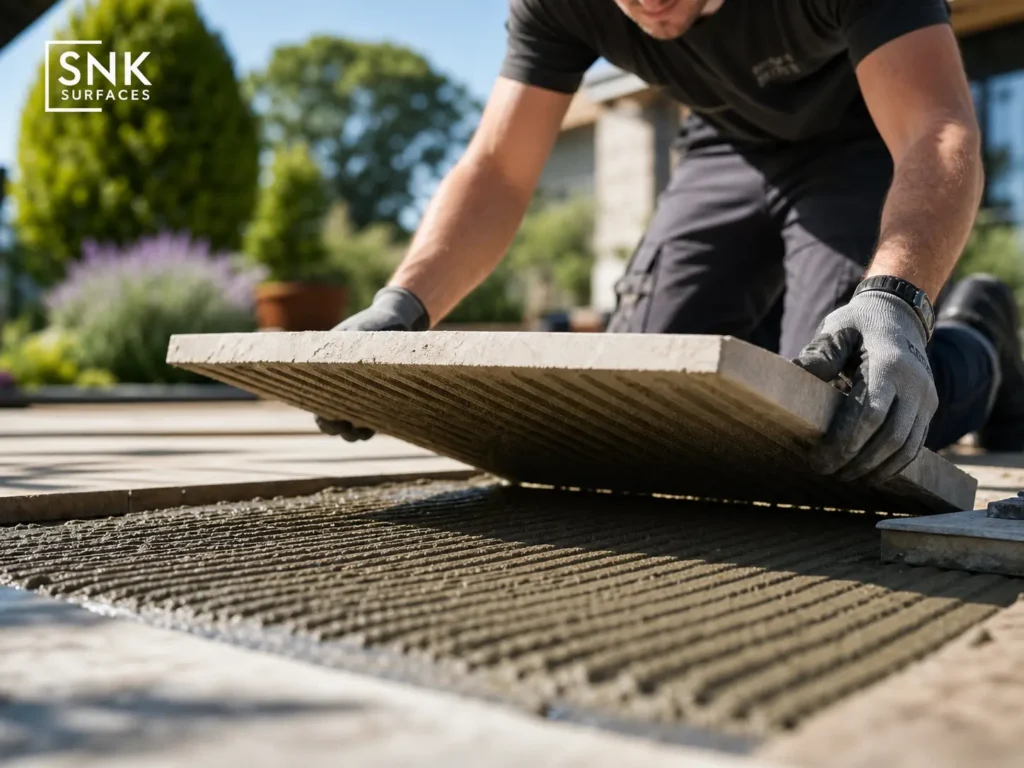
With 22mm calibrated slabs, the team prepares one flat screeded mortar bed across the whole area and simply drops the slabs into place. Every slab is the same depth, so the surface stays perfectly level without constant adjustments.
The result: Installation time can be cut by up to 50%. For UK landscapers paying skilled tradespeople by the day, this saving is enormous.
2. Stronger Bond Better Mortar Adhesion
When the diamond blades cut the underside of a calibrated slab, they leave behind a series of fine parallel grooves or ribs. These grooves are not a defect they are a feature.
When a landscaper applies a cement slurry primer and presses the slab into the mortar, the wet cement grips into those grooves and creates a mechanical bond. This significantly reduces the chances of slabs lifting, rocking, or cracking especially after a harsh UK winter.
Uncalibrated stone has a naturally smooth underside in many places, which gives the mortar far less to grip onto.
3. Better Container Yields Lower Shipping Cost Per Square Metre
This is the point that matters most for UK importers and builders merchants. Understanding the container yield difference in the calibrated vs uncalibrated sandstone paving debate is what often makes the final sourcing decision for serious trade buyers.
Ocean freight from India to the UK is charged by both weight and volume. Uncalibrated stone with slabs ranging from 25mm to 45mm thick is bulky and inefficient to pack. A standard 20-foot container loaded with uncalibrated sandstone typically holds around 400 square metres before hitting its weight limit.
By standardising to 22mm, we can pack the stone far more densely. At SNK Surfaces, a single 20-foot container of calibrated sandstone holds up to 550 square metres.
That is 150 extra square metres per container at zero extra shipping cost. For importers, that difference goes directly to your profit margin.
4. Compatible with Modern Pedestal and Dry-Lay Systems
Many modern commercial projects rooftop terraces, high-rise balconies, and public courtyards now use adjustable pedestal systems instead of traditional wet mortar.
These systems require every slab to sit level on small plastic supports at each corner. If the stone thickness varies even slightly, the surface becomes uneven and creates a serious trip hazard.
For projects that also include a swimming pool, our L-shape porcelain pool coping is designed to work perfectly alongside calibrated sandstone paving giving your pool edge and surrounding patio a seamless, coordinated finish that looks like one single premium project.
5. Consistently Level Surface Better Drainage and Safety
A flat patio surface is not just about aesthetics. It prevents water pooling, stops garden furniture from wobbling, and ensures even weight distribution across the mortar bed.
When the stone thickness is unpredictable, even an experienced landscaper can end up with slabs resting on high points of mortar with hollow voids underneath. When heavy weight is applied above a void a hot tub, a large planter, heavy foot traffic the slab can crack.
Calibrated stone eliminates this risk by ensuring every slab sits on a full, even mortar bed.
Does Thicker Mean Stronger? The 22mm vs 30mm Question
This is one of the most common questions we hear from UK homeowners and developers.
The honest answer is no thickness alone does not determine strength.
The structural integrity of a patio comes almost entirely from what is underneath the stone the compacted MOT Type 1 sub-base and the full, solid mortar bed.
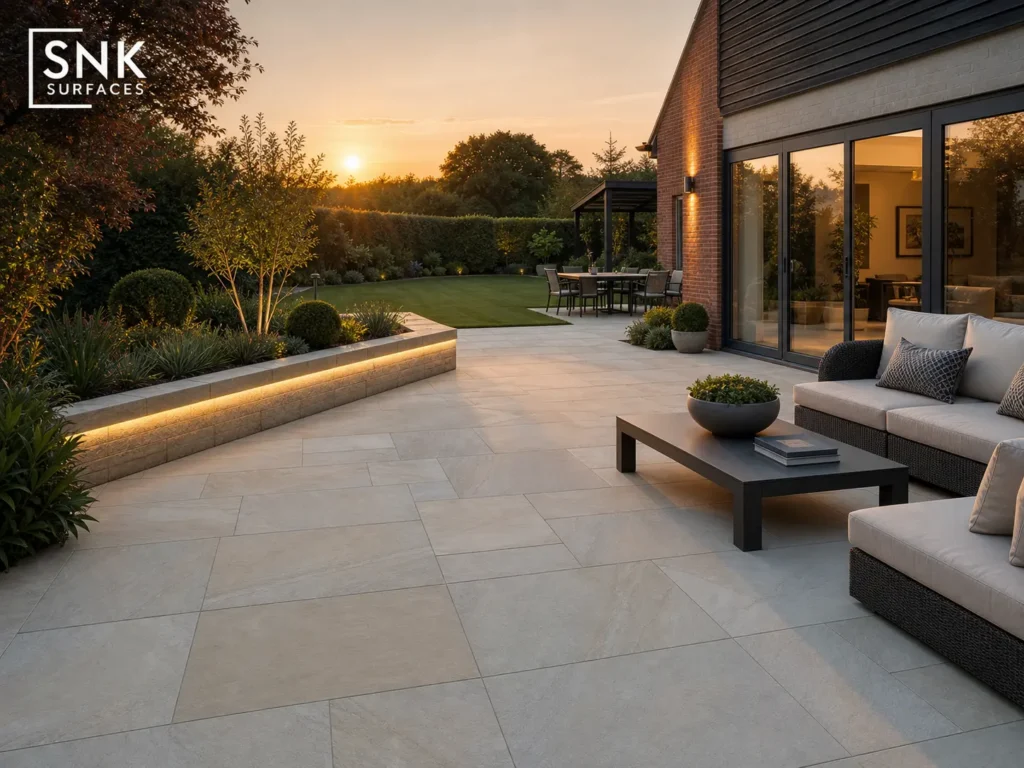
A 22mm calibrated slab laid correctly on a proper foundation will not crack under normal domestic use. Our Kandla Grey sandstone and Mint sandstone, calibrated to 22mm, are tested to withstand heavy foot traffic, UK frost cycles, and the weight of heavy garden furniture.
One important exception: For driveways that will take the weight of vehicles, 22mm patio slabs are not suitable calibrated or uncalibrated. For driveways, you need thicker material typically 30mm to 50mm sandstone setts or cobbles laid on a properly engineered sub-base.
Meeting UK Standards BS 7533 and UKCA Certification
For contractors working on commercial projects or high-end residential builds in the UK, compliance with British Standards is non-negotiable.
The relevant standard for natural stone paving installation is the BS 7533 series specifically BS 7533-102:2025, which covers the installation of modular paving units including natural stone.
Using 22mm calibrated stone makes meeting BS 7533 significantly easier. Because the stone depth is a fixed, known variable, engineers and contractors can accurately calculate the exact depths needed for the sub-base and mortar bed without accounting for unpredictable thickness variations.
One important installation note: Always lay natural stone on a full, continuous mortar bed. The old “dot and dab” method five spots of mortar at the corners does not meet current UK industry standards and will eventually lead to cracked and failed slabs.
The Real Cost Material Price vs Labour Price
A very common question among UK trade buyers researching calibrated vs uncalibrated sandstone paving is about the price difference. Uncalibrated stone is often slightly cheaper per square metre than calibrated stone. This makes sense it skips the expensive milling process at the factory.
But buying uncalibrated stone is a false economy.
Here is why:
- You save a few pounds per square metre on the material
- You then spend significantly more on labour because installation takes nearly twice as long
- UK landscaping labour is expensive day rates quickly wipe out any material savings
- You also pay to ship extra stone thickness that simply gets buried in the mortar
The most cost-effective decision is always calibrated stone. The slightly higher material cost pays for itself before the landscapers have even finished the first day of laying.
Sourcing Calibrated Sandstone Direct from the Manufacturer
When importing calibrated sandstone from India, the quality of calibration matters enormously. Many UK buyers who have researched calibrated vs uncalibrated sandstone paving thoroughly still get caught out by suppliers who cut corners on the milling process.
Some lower-tier suppliers allow 18mm or 20mm slabs to pass through unchecked, creating weak points hidden inside your patio pack. You will not discover the problem until the slabs start cracking on site.
At SNK Surfaces, we are a direct manufacturer based in Morbi, India the global hub of natural stone and porcelain tile manufacturing. Every slab goes through rigorous quality control at our facility before it is packed into export crates.
We guarantee true 22mm calibration for all our UK and European buyers.
All our sandstone is fully UKCA marked the certification that replaced CE marking in Great Britain after Brexit. This confirms our stone has been independently assessed and meets all UK health, safety, and environmental standards.
We export container loads of calibrated sandstone including our exclusively quarry-owned Fort White Sandstone to the UK, Ireland, and across Europe. If you are a UK landscaper, stone merchant, property developer, or importer looking for direct-from-manufacturer pricing and reliable container supply, our export team is ready to help.
Frequently Asked Questions
What is the exact thickness of calibrated Indian sandstone?
The UK and European industry standard for calibrated Indian sandstone is 22mm, with a generally accepted tolerance of +/- 2mm to account for the natural riven texture on the top surface of the slab.
Is uncalibrated sandstone bad?
No, uncalibrated sandstone is not bad. It is simply in its natural, unprocessed state and is still a beautiful, durable stone. However, it is significantly more time-consuming and expensive to install correctly, which is why the UK trade has moved away from it for most modern projects.
Why does calibrated sandstone have lines on the back?
The parallel lines or ribs on the underside of calibrated slabs are the cut marks left by the diamond-tipped saw blades during the milling process. These grooves are highly beneficial they provide a rough texture that allows the mortar and slurry primer to grip the stone much more firmly, creating a stronger and more durable bond.
H3: Can I use 22mm calibrated sandstone for a driveway?
No. Standard 22mm calibrated sandstone slabs are designed for pedestrian use on patios, pathways, and garden areas. For driveways that will carry the weight of vehicles, you need thicker materials typically 30mm to 50mm natural stone setts or cobbles laid on a properly engineered sub-base.
What is a mixed patio pack?
A mixed patio pack sometimes called a project pack contains a combination of different slab sizes, typically 600x900mm, 600x600mm, 600x290mm, and 290x290mm. When laid together they create a traditional random paving pattern. At SNK Surfaces, every slab in our mixed patio packs is calibrated to the same consistent 22mm thickness.
How do I get a trade quote from SNK Surfaces?
Simply visit our Sandstone Paving Collection page or contact our export team directly. We provide rapid container pricing for UK and European importers, builders merchants, and trade buyers. We ship full and part-container loads with full UKCA documentation.
Ready to Source Calibrated Sandstone Direct from the Manufacturer?
If you are a UK importer, builders merchant, landscape architect, or property developer looking for premium quality calibrated Indian sandstone at direct-from-manufacturer pricing SNK Surfaces is ready to help.
- True 22mm calibration guaranteed
- UKCA certified for the UK market
- Full and part-container loads available
- Up to 550sqm per 20-foot container
- Rapid trade quotes within 24 hours
- Samples available on request
Contact our export team today for container pricing
Browse our full Sandstone Paving Collection