




When specifying hardscaping materials for commercial plazas, pedestrianized urban zones, or public transport hubs, aesthetics are secondary to public safety. In the UK, a slip and fall accident in a public realm is not just a tragedy; it is a significant liability issue for the specifying architect, the civil engineer, and the local authority.
For commercial specifiers, mitigating this risk means relying on strict, quantifiable data specifically by sourcing compliant BS EN 1341 natural stone paving that meets the required Pendulum Test Value (PTV).
At SNK Surfaces, our three decades of experience in sourcing natural stone for commercial projects and exporting to 40 countries have taught us that true commercial value lies in technical transparency. This guide breaks down exactly how to specify natural stone paving that meets Health and Safety Executive (HSE) standards for slip resistance without compromising on architectural design.
Understanding the Standard: Why BS EN 1341 Natural Stone Paving is the UK Benchmark
Before any material can be legally and safely laid in a UK commercial project, you must specify certified BS EN 1341 natural stone paving.
This British and European standard is the ultimate benchmark for commercial paving. It dictates the rigorous testing protocols a stone must undergo before it receives its UKCA and CE marking compliance and Declaration of Performance (DoP). As outlined in the UKCA construction product regulations, while BS EN 1341 covers multiple physical properties including flexural strength, freeze-thaw resistance, and water absorption its most critical safety component for pedestrian zones is slip resistance.
Specifiers cannot simply rely on generic terms like “anti-slip” or “textured.” Under BS EN 1341, the slip resistance of natural stone must be scientifically measured and declared using specific testing methodologies to prove compliance for heavy public use.
Decoding Slip Resistance: BS EN 14231 and the Pendulum Test (PTV)
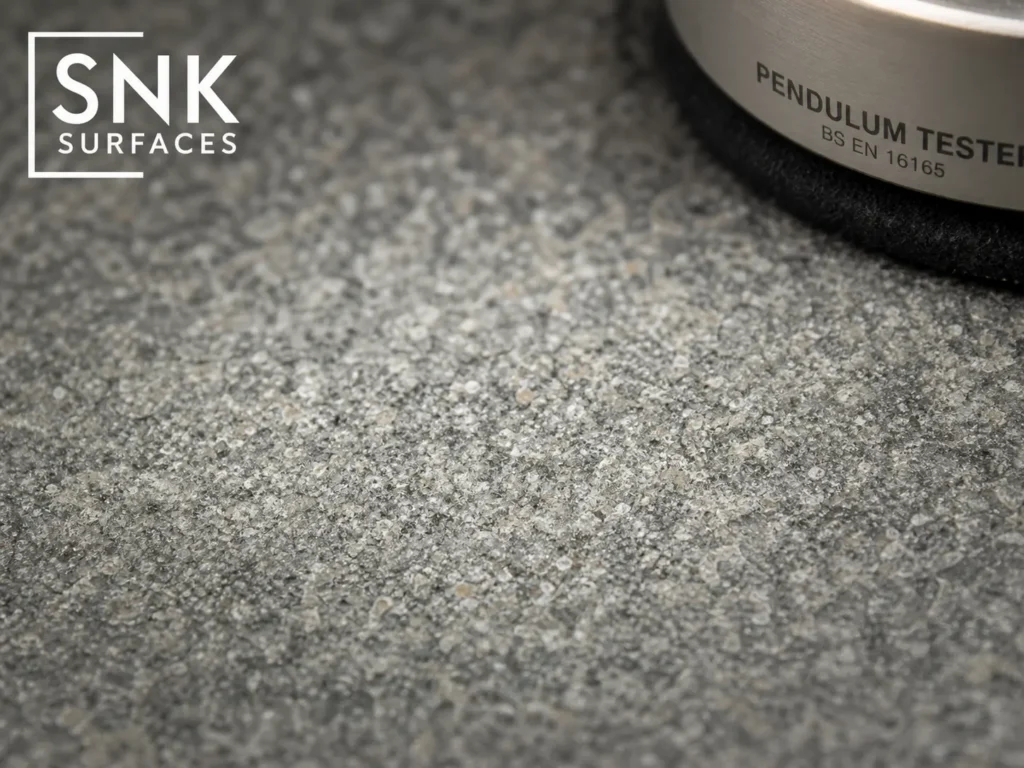
To satisfy the slip resistance requirements of BS EN 1341 natural stone paving, the material is tested under a secondary standard: BS EN 14231 (Determination of the slip resistance by means of the pendulum tester).
In the UK, the Health and Safety Executive (HSE) slip resistance guidelines and the UK Slip Resistance Group (UKSRG) strongly recognize the Pendulum Test as the gold standard for measuring floor slipperiness, heavily favoring it over the German Ramp Test (which yields an ‘R-rating’). The Pendulum Test is preferred because it accurately replicates the dynamic friction of a human heel striking the floor the exact moment when most slips occur.
How the Pendulum Test Works
The test uses a swinging pendulum fitted with a standardized rubber slider that sweeps across the stone’s surface.
- Slider 96 (formerly Four S): A harder rubber used to simulate the profile of a standard shod foot (a pedestrian wearing shoes). This is the standard for high streets and plazas.
- Slider 55 (formerly TRL): A softer rubber used to simulate barefoot traffic, which is crucial for swimming pool surrounds and wet leisure areas.
The test is conducted in both dry and water-contaminated (wet) conditions. The resistance the stone applies to the swinging rubber yields a number from 0 to 150, known as the Pendulum Test Value (PTV) or Unpolished Slip Resistance Value (USRV).
HSE PTV Thresholds for Public Safety
When specifying BS EN 1341 natural stone paving for a commercial outdoor space in the UK, your material must achieve a specific PTV rating in wet conditions to avoid liability. The HSE categorizes slip potential as follows:
| PTV Rating | Slip Potential | Risk Level (Approximate) | Specifier Action |
| 0 – 24 | High | 1 in 20 chance of slipping | Unsuitable for wet outdoor public areas. |
| 25 – 35 | Moderate | 1 in 100,000 chance of slipping | Requires caution; unacceptable for heavy public footfall. |
| 36+ | Low | 1 in 1,000,000 chance of slipping | The minimum benchmark for safe, wet commercial environments. |
| 75+ | Extremely Low | < 1 in 1,000,000 chance of slipping | Ideal for steep inclines or heavy industrial use. |
For any standard UK public realm project such as a high-street pavement, a train station concourse, or a commercial plaza a minimum wet PTV of 36 is the absolute baseline requirement.
Surface Finishes & Their Impact on Slip Resistance Values

High-quality BS EN 1341 natural stone paving is highly versatile, but its slip resistance is dictated almost entirely by its surface finish.Because SNK Surfaces operates directly from the quarry, we can process our Indian Sandstone and Granite slabs with specific mechanical finishes designed to far exceed a PTV of 36.
When specifying stone for high-traffic areas, consider how these finishes impact both the aesthetics and the USRV:
1. Riven Finish (Natural Cleft)
Riven sandstone (such as natural Kandla Grey Indian Sandstone) is split naturally along its geological fault lines. This leaves a beautifully textured, undulating surface.
- Slip Resistance: Generally excellent. The natural ridges provide a high dynamic coefficient of friction, easily achieving PTVs well above 40 in wet conditions.
- Best For: Heritage projects, traditional public gardens, and commercial spaces seeking an organic aesthetic.
2. Shotblasted Finish
Shotblasting involves firing tiny steel beads at the stone’s surface at high velocity. This creates a finely textured, stippled finish that removes the natural riven ridges while massively increasing micro-roughness.
- Slip Resistance: Outstanding. Shotblasting yields highly consistent PTV scores, making it one of the safest choices for commercial footpaths.
- Best For: Modern urban plazas, wheelchair-accessible ramps, and transit stations.
3. Flamed (Thermal) Finish
Most commonly applied to commercial granite paving, flaming exposes the stone to a high-temperature blowtorch, causing the surface crystals to burst.
- Slip Resistance: Exceptional. Flamed granite provides an incredibly aggressive grip, routinely scoring PTVs in the high 60s and 70s.
- Best For: Heavy-duty urban environments, bus terminals, and high-footfall commercial walkways.
4. Honed Finish (Use with Caution)
Honing grinds the stone to a completely smooth, matte finish. While visually stunning for indoor hotel lobbies, honing removes the micro-roughness necessary to grip a shoe.
- Slip Resistance: Often falls below the critical PTV 36 threshold when wet.
- Best For: Indoor commercial spaces only. If specified outdoors, it must be kept strictly dry or treated with specialized anti-slip chemical sealants.
The Hidden Dangers: Weathering, Water, and Long-Term PTV Retention

Specifying a stone that achieves a wet PTV of 40 in a pristine laboratory setting is only half the battle. Civil engineers must account for how that stone will perform after five years of heavy foot traffic and freezing UK winters.
Freeze-Thaw Resistance (F-Rating)
To qualify as authentic BS EN 1341 natural stone paving, the material is rigorously tested for frost resistance. In the UK climate, highly porous stones absorb rainwater. When that water freezes, it expands, causing the surface of the stone to spall or flake. If the textured surface degrades, the stone loses its slip resistance and becomes a hazard. Commercial specifiers should always demand stone with an F1 rating (frost resistant), ensuring the structural integrity and the PTV remains intact over decades.
Biological Contamination
In shaded urban areas, algae and moss thrive on damp surfaces. Even a shotblasted stone with a dry PTV of 65 can act like an ice rink (dropping to a PTV of <20) if coated in wet algae. Specifying denser stones with lower water absorption rates (such as high-grade Indian Sandstone or Granite from SNK Surfaces) prevents deep biological rooting, allowing standard street-cleaning regimens to easily wash away slip hazards.
Specifier Checklist: What Commercial Procurement Officers Need from Their Supplier
To protect yourself from liability and ensure your project meets all UK regulatory standards, never specify BS EN 1341 natural stone paving from a supplier who cannot provide transparent, technical data. When auditing a quarry-direct supplier or importer, demand the following:
- Declaration of Performance (DoP): A legal document detailing the stone’s performance characteristics under BS EN 1341.
- Current PTV / USRV Data: Lab-tested pendulum scores (BS EN 14231) utilizing Slider 96 for both wet and dry conditions.
- Water Absorption Rates: To determine susceptibility to algae and winter frost damage.
- Flexural Strength Data: To ensure the slab thickness is appropriate for pedestrian vs. vehicular loads.
- Ethical Sourcing Proof: EPDs (Environmental Product Declarations) and ethical labor guarantees, which are vital for securing BREEAM credits on commercial builds.
Conclusion: Balancing Architectural Vision with Safety Compliance
Specifying natural stone for UK commercial projects doesn’t mean choosing between aesthetic beauty and public safety. By specifying fully certified BS EN 1341 natural stone paving and ensuring a minimum wet Pendulum Test Value (PTV) of 36, civil engineers and landscape architects can design inspiring urban spaces while confidently mitigating slip and fall liabilities.
When you source BS EN 1341 natural stone paving directly from quarry owners who control the mechanical processing from shotblasting to thermal flaming you gain the technical transparency and batch consistency required to deliver projects safely, on time, and within your commercial budget.
Secure Your Commercial Tenders with Direct-from-Quarry Stone
Are you working on an upcoming public realm project, transit hub, or commercial development in the UK?
At SNK Surfaces, we bypass the middlemen to provide full technical documentation including certified Declaration of Performance (DoP) sheets, EN 1341 testing data, and wet PTV ratings for our entire range of premium BS EN 1341 natural stone paving.
- Request Technical Data Sheets & DoP Documentation
- Order Certified Commercial Stone Sample Boxes
- Discuss Container Shipping & Wholesale Pricing for UK Projects
Contact Our Commercial Specification Team Today or email our commercial export desk to request technical samples for your next tender.
Frequently Asked Questions (FAQs)
What is the minimum PTV rating required for commercial paving in the UK?
Under Health and Safety Executive (HSE) guidelines, outdoor commercial paving in the UK must achieve a minimum Pendulum Test Value (PTV) of 36 in wet conditions using Slider 96 rubber. A PTV of 36 or higher indicates a “low slip potential” (a 1 in 1,000,000 risk of slipping), making it safe and compliant for public footfall.
What is the difference between BS EN 1341 and BS EN 14231?
BS EN 1341 natural stone paving refers to materials that meet the overall European and British standard specifying requirements and test methods for external slabs. BS EN 14231 is the specific test method referenced within BS EN 1341 that dictates exactly how the slip/skid resistance of that stone is measured using a pendulum tester.
What is the difference between Slider 96 and Slider 55 in slip testing?
In Pendulum Test Value (PTV) testing, Slider 96 (formerly Four S rubber) simulates standard pedestrian footwear (shoes) and is required when specifying stone for public streets, plazas, and commercial walkways. Slider 55 (formerly TRL rubber) is a softer compound that simulates bare feet, making it the required standard for wet leisure zones, swimming pool surrounds, and barefoot changing areas.
Does natural stone lose its slip resistance over time?
Yes, slip resistance can degrade over time due to heavy foot traffic polishing the stone’s surface, or through the accumulation of biological contaminants like algae, moss, and dirt. Specifying highly frost-resistant natural stone with aggressive mechanical finishes (like shotblasting or flaming) ensures that a wet PTV above 36 is maintained throughout the pavement’s operational lifespan.
Can I get Declaration of Performance (DoP) certificates directly from SNK Surfaces?
Absolutely. As direct quarry owners and international exporters serving over 45 countries, SNK Surfaces provides complete technical documentation. We supply comprehensive documentation for all our BS EN 1341 natural stone paving, including flexural strength reports, and certified PTV slip test scores for all bulk commercial shipments into the UK market.