
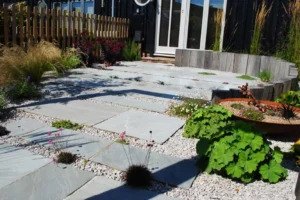

Kandla Grey porcelain vs sandstone comes down to one trade-off: choose porcelain if you want a fit-and-forget surface — under 0.5% water absorption, no sealing, consistent colour in every batch. Choose Kandla Grey sandstone if you want the authentic riven texture and natural variation of the original Rajasthan stone, and don’t mind resealing every year or two. Below is the full comparison, with the actual standards and test data most guides skip.
• Both handle UK, Irish and Northern European frost, but porcelain’s near-zero absorption makes freeze-thaw damage far less likely.
• R11-rated porcelain gives certified slip resistance; riven sandstone relies on its natural texture.
• Standard thickness: 20mm for outdoor porcelain, ~22mm for calibrated riven sandstone.
• Neither is “better” — they suit different projects, budgets and maintenance appetites.
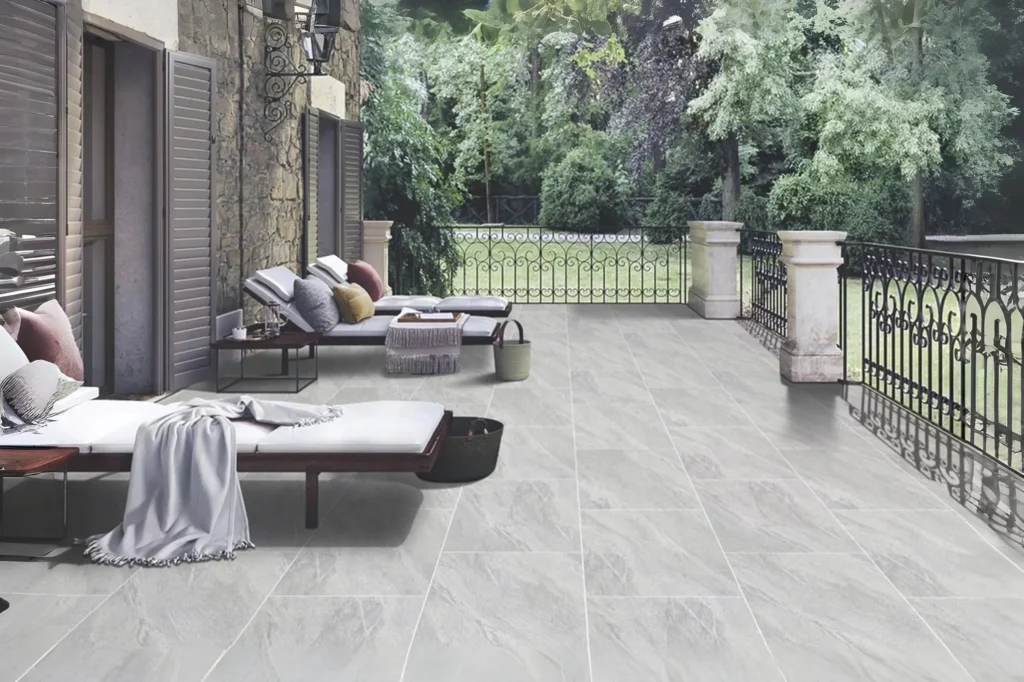
What Is Kandla Grey — and Why Are There Two Versions?
Kandla Grey started as a natural sandstone sourced from India’s established sandstone-producing regions. It is known for its silver-grey tones, natural grain, and hard-wearing character, making it a popular choice for outdoor paving and landscaping. [Litos Online – Kandla Grey Sandstone India](https://www.litosonline.com/en/article/kandla-grey-sandstone-india) Porcelain manufacturers later developed **Kandla Grey porcelain**, a vitrified paving product designed to replicate the colour and visual character of natural Kandla Grey while offering the technical properties associated with porcelain. SNK Surfaces supplies natural sandstone and manufactures porcelain surfaces, allowing us to support buyers comparing both options based on appearance, performance, maintenance, and project requirements.
Kandla Grey Porcelain vs Sandstone: The Full Comparison
The table below summarises the eight factors that decide most projects. Details and sources follow in each section.
| Factor | Kandla Grey Porcelain | Kandla Grey Sandstone |
|---|---|---|
| Water absorption | ≤ 0.5% (ISO 13006 Group BIa) | Higher — porous by nature; benefits from sealing |
| Frost resistance | Excellent — almost no water to freeze | Good when sealed and correctly laid |
| Slip resistance | Certified R11 (DIN 51130) | Natural riven texture (not lab-certified) |
| Maintenance | No sealing ever; wash down as needed | Seal on installation, reseal every 1–2 years |
| Appearance | Consistent colour and pattern batch to batch | Unique variation — no two slabs identical |
| Thickness | 20mm standard for outdoor use | ~22mm calibrated riven standard |
| Typical cost | Higher per m² upfront | Lower per m² upfront; sealing adds lifetime cost |
Water Absorption and Frost: The Biggest Technical Difference
Porcelain paving is classified under EN 14411 / ISO 13006 as Group BIa — dry-pressed ceramic with water absorption of 0.5% or less. That’s not marketing language; it’s the defining threshold of the standard itself.
Sandstone, as a rock family, holds far more water — geological surveys such as the Wisconsin Geological & Natural History Survey put sandstone porosity at some of the highest of any rock type. Dense paving-grade Kandla Grey sits at the low end of that spectrum — it’s a hard, quartz-rich stone — but it will always absorb more water than vitrified porcelain.
Why this matters in the UK, Ireland and Northern Europe: frost damage happens when absorbed water freezes and expands inside the stone’s pores, opening micro-cracks that grow with every freeze-thaw cycle. The less water a material can absorb, the less there is to freeze — which is why porcelain’s near-poreless structure makes it effectively frost-proof, while sandstone depends on good drainage, correct installation and sealing to perform through hard winters.
Slip Resistance: What R11 Actually Means
Quality outdoor porcelain carries an R11 rating under DIN 51130 — the German ramp test in which a person in treaded boots walks on an oil-coated, tilting ramp. The angle at which they slip determines the class, from R9 (lowest) to R13 (highest). R11 corresponds to a 19–27° acceptance angle, suitable for wet outdoor areas, as explained by slip-testing specialists Safety Direct America and Slip-Not UK.
Natural riven Kandla Grey offers genuinely good grip through its split-face texture — it’s one of the reasons the stone became a UK patio staple. The difference is certification: porcelain gives you a lab-tested number to put in a project spec; natural riven stone gives you texture that varies slab to slab.
Maintenance: Sealed vs Fit-and-Forget
This is where most buyers ultimately decide. Sandstone’s porosity means it benefits from sealing at installation and resealing every one to two years to resist staining, moss and algae — standard guidance across the UK stone trade, including specialists like Westminster Stone. Porcelain never needs sealing: its vitrified surface won’t absorb oils, won’t host moss, and cleans with soapy water.
For a homeowner who enjoys garden upkeep, resealing is a minor weekend job. For a commercial site, a rental property, or anyone specifying low-maintenance landscaping, porcelain’s zero-sealing regime usually wins the argument on its own.
Appearance: Consistency vs Character
Porcelain’s advantage is repeatability every batch of Kandla Grey porcelain matches the last, which matters for large projects, phased installations, or future extensions. Its printed surface is remarkably close to the real stone, though patterns repeat across a production run.
Natural sandstone has a unique advantage: every slab has its own natural character. Its riven surface, subtle colour variations, and mineral patterns create a depth and texture that manufactured surfaces are designed to replicate. If your project prioritises an authentic natural appearance and the individuality of real stone, Kandla Grey sandstone is a strong choice. Porcelain offers a more uniform and consistent alternative, so the right option depends on the look and performance requirements of your project.
Thickness, Weight and Installation
Outdoor porcelain is standardised at 20mm thickness, while calibrated riven sandstone is conventionally supplied at ~22mm (sawn sandstone often 20mm) — the accepted UK trade conventions documented by suppliers such as Pave Direct and Melton Stone.
Installation differs more than thickness suggests: porcelain’s low porosity means it needs a priming slurry for adhesion and diamond blades for cutting, while sandstone cuts and beds more traditionally. Experienced landscapers handle both; DIY installers generally find sandstone more forgiving.
So Which Should You Choose?
- Choose Kandla Grey porcelain if: you want certified slip resistance, zero sealing, maximum frost security, and batch-to-batch colour consistency — typical for commercial projects, developments, and low-maintenance homes. See our Kandla Grey porcelain paving range (600x900mm, R11, UKCA & CE certified).
- Choose Kandla Grey sandstone if: If you want authentic natural stone with natural variation and a riven texture, while keeping the upfront cost lower, sandstone can be a practical choice if you are comfortable with periodic maintenance and sealing. Explore our [natural stone range](https://snksurfaces.com/product-category/natural-stone/) to find options suited to your project requirements.
- Still weighing the broader question? Our full guide to porcelain vs natural stone paving covers cost, sustainability and installation in more depth.
Frequently Asked Questions
Is Kandla Grey porcelain better than Kandla Grey sandstone?
Neither is universally better. Porcelain offers lower water absorption (≤0.5%), certified R11 slip resistance and zero sealing; sandstone offers authentic natural texture and variation at a lower upfront price. The right choice depends on your maintenance appetite, budget and whether colour consistency matters for your project.
Does Kandla Grey sandstone need sealing?
Yes — UK stone trade guidance recommends sealing sandstone at installation and resealing every one to two years. Sealing protects the porous surface from staining, moss and algae. Kandla Grey porcelain, by contrast, is vitrified and never requires sealing at any point in its life.
Is Kandla Grey porcelain frost-proof?
Effectively, yes. Porcelain classified under ISO 13006 Group BIa absorbs 0.5% water or less, so there is almost no moisture inside the tile to freeze and expand. This makes freeze-thaw cracking extremely unlikely, even through repeated UK, Irish and Northern European winter cycles.
What sizes does Kandla Grey porcelain come in?
The most common outdoor format is 600x900mm at 20mm thickness — the standard for outdoor porcelain paving. Kandla Grey sandstone is typically supplied as calibrated riven slabs around 22mm thick, often in mixed-size patio packs that create a traditional laid pattern.
Where does Kandla Grey stone come from?
Kandla Grey is a natural sandstone sourced from the established sandstone-producing regions of Rajasthan, India. It is known for its hard-wearing character, grey tones, and natural variation. Kandla Grey porcelain is manufactured in Morbi, Gujarat, and is designed to replicate the look of natural Kandla Grey in a vitrified porcelain format.
Sourcing either version? We supply Kandla Grey sandstone and manufacture Kandla Grey porcelain for container-direct delivery to the UK, Ireland and Europe, supporting importers, distributors and contractors with certified products, export-ready packing and free samples before you commit. Get a quote.